


A Collection of Articles About  School Wellbeing

NB please reference when using

                Six Essential Strategies for Stressed Educators

By Dr Helen Street

PositiveSchools.com

If you are an educator struggling with overwhelm in your day to day life, here are six proven and powerful strategies to add to your stress management first aid kit.

  1. Separate Yourself from your Symptoms

One of the most helpful steps we can take in managing day-to-day stress is learning to notice and acknowledge our physical signs and symptoms.

When we can learn to do this, we can learn to notice how stress is impacting us, without letting it define us. This helps us understand ourselves more fully, feel more in control, and also, feel less overwhelmed.

  1. Try naming the signs and symptoms you are experiencing when you are feeling stressed. For example, you may be experiencing rapid breathing, tension in your muscles, sweat, shaky legs, extreme feelings of fatigue etc.
  2. Separate yourself from your symptoms, by naming them as experiences you are observing rather than completely consumed by. For many people it helps to talk to yourself as a second person. For example, you may say to yourself “you’ are breathing very quickly.” “Your heart is racing.” “Your teeth are clenched” etc.
  3. As you become the observer of your response, take action to shift it to one of greater focus and calm. For example, deliberately slow your breathing, let go of gritted teeth and relax your jaw, let your shoulders drop back into position.

When we notice and acknowledge our symptoms, we become less consumed by our stress, and feel more separate from it.

  1. Create Breathing Space

When stress begins to accumulate, taking a moment to consciously, intentionally breath calmly and slowly, tells our body that we are not in a life-threatening situation, even though we may be facing a tough challenge.

When we feel overwhelmed, our breathing often becomes shallow and rapid. This pattern signals to our body that real physical danger may be present, which can intensify an ongoing, debilitating threat response.  Slow, deliberate breathing sends the opposite signal.  It tells our nervous system that the situation is manageable. Shifting our breathing from fear to engagement is simple, yet one of the most powerful ways we can physically shift our stress response in the moment.

One helpful technique involves taking slow breaths that are longer on the exhale than the inhale.

For example:

  1. Breathe in slowly for four seconds.
  2. Breathe out slowly for six seconds.
  3. Repeat several times.

This pattern activates our in-built calming systems and helps restore our perceived sense of control. 

As you turn to walk to the front of the room, as you turn to the board, as you grab a new pen from the drawer….smile, lower your shoulders and slowly, deliberately...breathe.

  1. Ground Yourself in the Present Moment

Stress often pulls our attention into the future. In this, we are perceiving our situation to be threatening rather than challenging, because we get caught up imagining one disastrous outcome after another.

In reality, things are rarely disastrous or life threatening in the current moment.

Grounding techniques help bring our attention back to the present, in which, nearly all the time, life is far more about addressing a challenge.

A simple grounding exercise might involve noticing:

  • five things you can see,
  • four things you can feel,
  • three things you can hear,
  • two things you can smell,
  • one thing you can taste.

This process helps interrupt spirals of anxious thinking and reconnects attention with the immediate environment. In busy school settings, even brief grounding moments can help us regain composure and clarity over the here and now.

  1. Challenge and Change Unhelpful Self-Talk

Another important element of stress first aid involves checking in with the way we talk to ourselves. Challenging the irrational and the unhelpful; and focusing on a more grounded and realistic response.

For example, when we feel overwhelmed, our internal dialogue can sometimes become unhelpfully harsh or even downright hysterical.  We might say to ourselves “I can’t handle this.” Or , “I’m failing.” Or even, “I’m going to die here, right now… in this year nine classroom…”

These thoughts intensify stress because they frame the situation as evidence of personal inadequacy to cope, and with ultimate disaster. 

More constructive self-talk takes a different approach.  Instead of criticising ourselves, we acknowledge the challenge while reminding ourselves of our capacity to survive, even if that means surviving a failure.  For example, positive reframes might include “this is a tough moment, but I’ve handled difficult situations before.” Or, “I care about this, which is why it feels stressful.” Or, perhaps, “I can take this one step at a time.”

Changing our self-talk is a powerful way of shifting our perceptions and changing the meaning of our stress response in a healthier direction.  Instead of signaling an unsurvivable event, stress becomes evidence of engagement with a challenging situation.

  1. Give Yourself Permission to Delay

Many of us occasionally encounter situations at work that trigger strong emotional reactions such as anger, frustration, embarrassment or anxiety.  Some of us encounter them regularly, however, in the midst of a busy school day, it may not be possible to process these emotions effectively. The year eight English class is probably not the best time to throw yourself to the floor or take a long nap at your desk.

So what can we usefully do instead?

In these moments, it can be both calming and helpful to delay our emotional response rather than try and suppress or deny it.

Delaying does not mean pretending the feeling does not exist, or that we refuse to address it. It means acknowledging we are having a very real, big emotional reaction…but choosing to process it later when we have the time and space to think more clearly. 

For example, imagine you receive critical feedback during a staff meeting. You might feel anger rise inside you or find yourself swallowing hard to avoid crying. Instead of pushing the feeling away, or telling yourself off you could say to yourself: “I’m feeling upset. This is real and it is OK, but I don’t have the time and space I need to express this now. I’ll come back to it later (e.g. at 6:00pm when I’m home), when I can be as upset as I need to be.”

This approach allows us to continue functioning in the moment while still honouring our emotional response.  Later, perhaps late afternoon with a cup of tea, when there is more space for reflection, we can fully acknowledge our emotions, feelings and thoughts, rather than trying to push them away.

We may well find that we no longer feel so upset simply because we did not deny our feelings earlier. We also have more space and capacity to address next steps more thoughtfully.

  1. Consider Stress as a Signal you Care

One of the most powerful immediate shifts we can make when we experience a wave of distress, is recognising that (nearly all the time) our experience signals something is important (and not that something is actually life threatening).

Stress appears when something matters. 

It appears when we care about our students, our teaching, and the impact of our work. Hence, kind and caring teachers often experience stress at school.

Instead of interpreting a moment of distress as evidence that you are failing, take a moment to re-interpret it as evidence that you are engaged with something that matters, and that is a good thing, even when it is a hard thing.

Certainly, there are many things we could change in education and certainly not every stressful situation is healthy.

But stress itself is not automatically a problem.

In many cases, stress reflects the presence of meaningful challenge. And meaningful challenge is the driver of meaningful change and growth.

What Next?

Did you find these pointers useful reminders for managing your stress day to day?

Are you an educator who would like a deeper dive into stress management, and how we might better embrace challenge?

Then join me for a full-day Wednesday workshop all about learning to lean into stress more helpfully and happily, at The Positive Schools conference, happening in three states in October/November this year.

Leaning into Stress is also available as an in-house workshop for your whole school staff. Contact us for 2027 bookings.

PositiveSchools.com.au

for conference information and registration


CONTEXTUAL WELLBEING

wellbeing that arises from being connected to a healthy social context


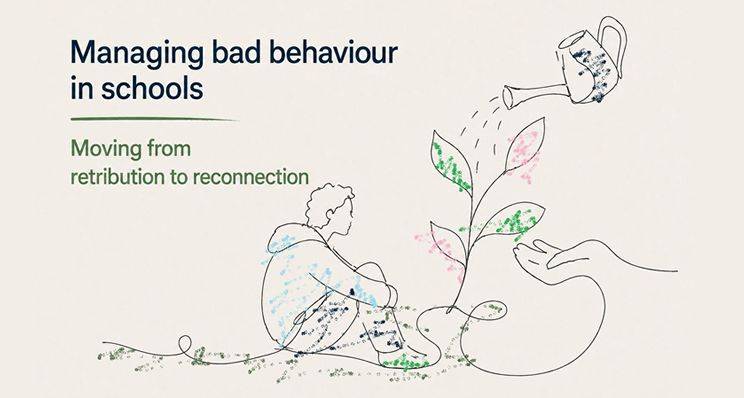
Untangling the Pursuit of Positive Behaviour –
A Matter of Morality
By Dr Helen Street, Sept 2025

School-based approaches to supporting positive behaviours among students have never been more
polarising or confusing. We all want students to exhibit desirable social behaviours, but it can be hard to
know what advice or guidance to take on board. More pressingly, it can be hard to know which
approaches might actually work to support student behaviour, student engagement and

Continue Reading
‘Positive Schools’ is NOT ‘Positive Education’ (but it might be one day...) Do you know the difference?

Positive Schools today is NOT the same thing as Positive Education today. These two approaches to supporting wellbeing in schools do not understand wellbeing in the same way, nor do they incorporate the same understanding of how wellbeing can best be put into action. These are bold statements, but they need making. Understanding what ‘Positive Schools’ is about now and beyond, needs discussion, exploration and clarification.

Continue Reading
Rose Tinted Memories of a Brave New World By Dr Helen Street, February 2025

Since the advent of touch-screen technology, there is no denying that most of us are fairly inseparable from our smart phones. Indeed, if I ever forget to take my phone out with me, I feel more than a little anxious.  This is despite me spending more than half my life confidently leaving home without a ‘device’ at hand.

What if....

Continue Reading
Why Depth is More Important than Breadth - A Comment on Whole School Wellbeing

Many schools seeking to support school wellbeing, are keen to support a ‘whole school approach’. This sounds like a great idea. After all, surely if we want all staff and students to benefit, and be well; best practice needs to be as universal as possible?
Unfortunately, as with many ideas taken at face value, conceptualizations of ‘whole school wellbeing programs’ can be dangerously ambiguous and substantially flawed.

Continue Reading
Why Schools Need to Spend Less Time Thinking About Students (and More Time Thinking About Culture)

Over the past twenty years, there has been an increasing consideration of the role schools can, and indeed ‘should’ play in supporting the mental health of young Australians. But good intentions do not always translate into good actions

Continue Reading
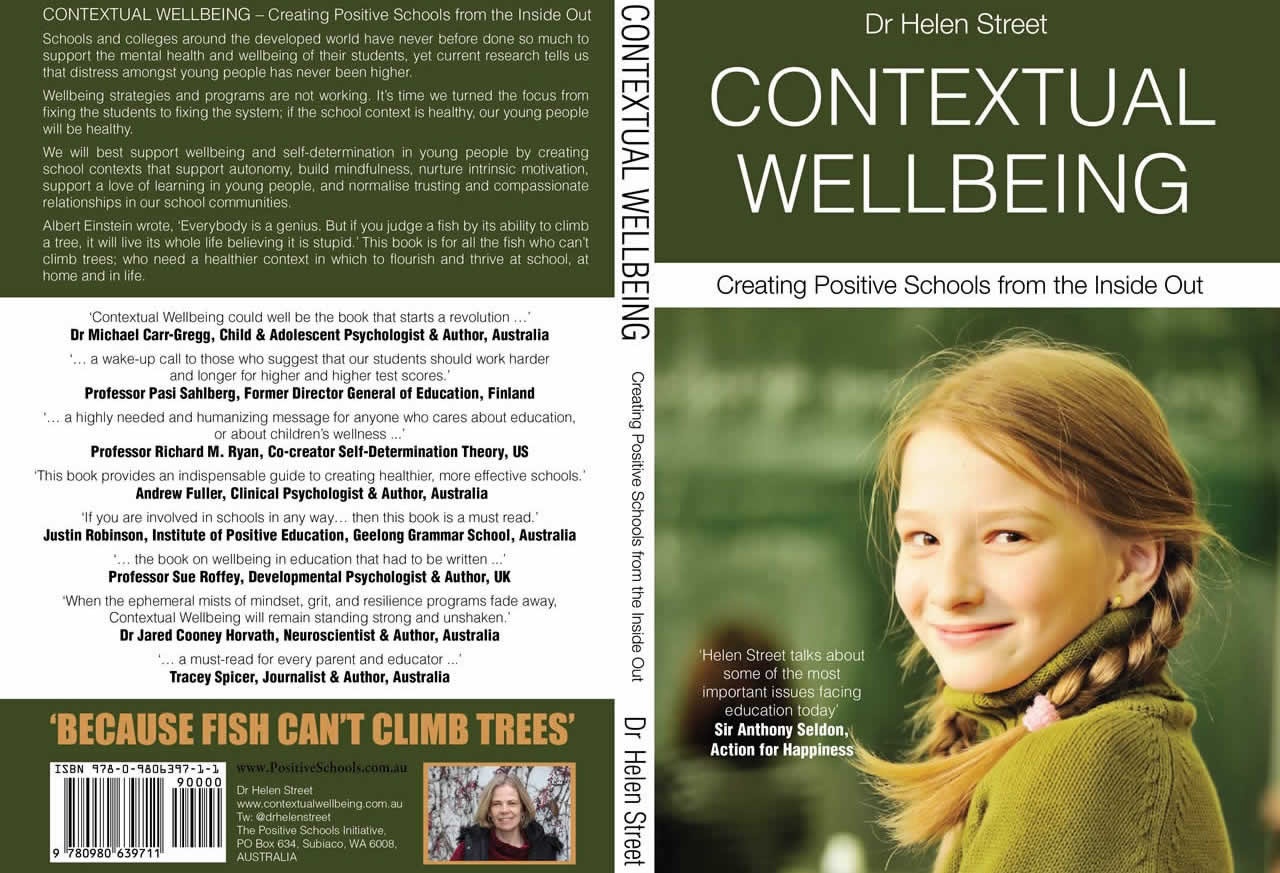
The Social Side of Wellbeing – an extract from Contextual Wellbeing

(this is an extract from: Street, Helen (2018) Contextual Wellbeing: creating positive schools from the inside out, published by Wise Solutions) …

Continue Reading

What Makes a Great Teacher Great?

There is no doubting the universally held belief that relationships matter in schools. In particular, the relationships teachers have with their students have been found to be a key driver of classroom experience, student learning engagement and overall student motivation and wellbeing at school[i].

But what does a healthy teacher: student relationship look like, sound like, and feel like?

Continue Reading

Rising to the Challenge: Rethinking Stress in Schools

Last year, a principal said to me, late in the afternoon, late in the term, “I just wish we could get rid of the constant stress we experience in this job.”
It had been one of those days for her. A staffing issue. A distressed parent. A student wellbeing concern. An urgent system email marked high priority. By the time we were talking, the weight of it all had felt overwhelming.

Continue Reading
Finding Joy Without Judgement - Part One - by Dr Helen Street

‘Behaviours and attitudes only become worthy of positive or negative judgements once they are enacted within a particular time, situation and culture.

Once these contextual factors are accounted for, behaviours and attitudes can be understood as helpful or unhelpful, as strengths or as weaknesses.

Thus, a strength-based approach needs to be about identifying attitudes and behaviours that are healthy within the limits of the context, rather than within the limits of the person.’

Continue Reading
Finding Joy Without Judgement - Part Two - by Dr Helen Street

‘A focus on values supports the development of contextual wellbeing with meaning and purpose.

Moreover, the exploration of values within a classroom, living room or board room, helps us to understand and pay attention to what matters, without limiting our understanding of ourselves, or of who we can become.

Continue Reading

Finding Motivation to do Hard Things

By Dr Helen Street

Positive Matters, August, 2023

It is all very well understanding the motivational power of intrinsically rewarding activities, but how do we help students to stay motivated when learning is tough?

Continue Reading

What to do in the
Wellbeing Session - By Dr Helen Street

One student I was chatting to recently said:
“It is not about being a great speaker or having a lot of information. It is still boring to hear from
wellbeing presenters who don’t know us and don’t know our school”.

Continue Reading